In India, the discussion around educational inequity is generally about what is missing: schools, infrastructure, teachers. Aryaman Chandra, a Grade 12 student at Heritage Xperiential Learning School, grew up seeing a second version of the problem – one without any of the gaps. He went between tier 1 and tier 2 cities and saw very different school systems produce the same result. Students were left behind in under-resourced settings because the resources just weren’t available. In well-resourced ones, students fell behind anyway, in classrooms that had everything, except a way of teaching that didn’t frighten them.
That fear is not anecdotal in scope. Globally, one in three students suffers from math anxiety, and India’s own numbers are in line with this: The 2026 CBSE On-Screen Controversy over marking drew more than 400,000 students into public battles over how their futures were being scored. Aryaman had watched this before, at close quarters, in an elder sister who had spent years in fear of a subject she was capable of grasping. At that point, for him, the research was no longer research.
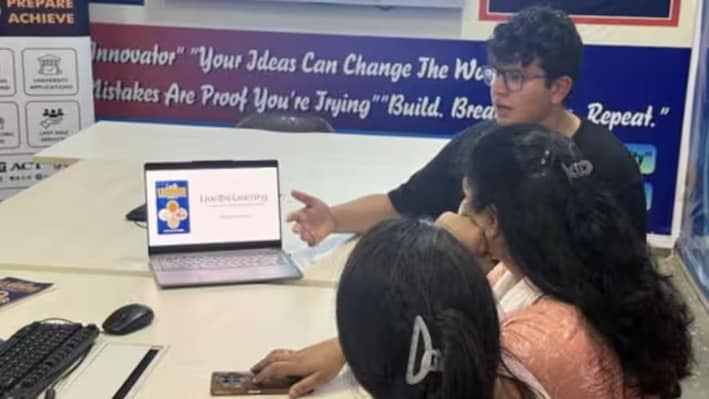
That was the problem Aryaman was going to redesign, not patch up. In 2024, he launched HeyArya!, an AI-enabled multilingual math tutoring platform based on Richard Feynman's teach-it-back method. If a student cannot explain a concept, he has not yet understood it. HeyArya! doesn’t ask students to drill for right answers, but to explain concepts themselves, and then uses that explanation to surface exactly where understanding breaks down before it calcifies into fear. He knew that a tool alone would not be sufficient to fix a curriculum that was built on memorization and high-stakes testing, so he also built the Live the Learning Guide – a nine-module experiential curriculum for CBSE and ICSE schools based on the IB’s CAS framework and Socratic inquiry aligned to the goals of NEP 2020. Where HeyArya! rebuilds a student’s relationship with math, LTL rebuilds the classroom itself, putting students in a position of designers rather than recipients. As a whole, the two programs serve as an instructional and psychological intervention.
The ambition has followed the reach. Hey, Arya! alone has grown to over 9,000 active users in 95 cities, cutting measured math anxiety by as much as 45 percent. The two programs have now merged to take on 12+ government and private schools, reaching thousands of students through classroom curricula and over 500 community-led projects.
“For me, it started with wanting other people to love math as much as I do,” Aryaman says. But it grew bigger than that. It became about giving every student the confidence that they are not behind, they just were never taught in a way that made sense to them. That belief is no small thing. It changes what a person thinks they can do, in math and everyplace else."
Seventeen-year-old Aryaman is not waiting for the system to change around him. He is adding the missing pieces, one classroom and one student at a time. In a country where the size of the challenge can render reform remote and slow, his work is a reminder that some of the most significant changes in education are not being designed in policy rooms, but by the students who are living inside the problem. Aryaman Chandra is shaping India’s education system of tomorrow.
Stay informed on all the latest news, real-time breaking news updates, and follow all the important headlines in india news and world news on Zee News English.