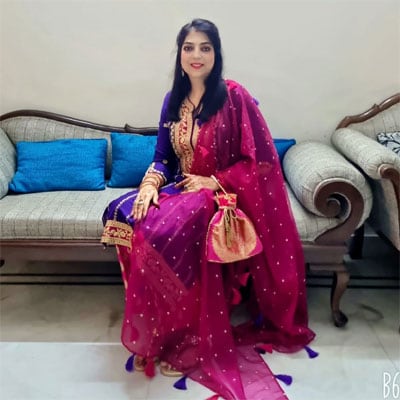
From Losing 70% revenue to a Rs 100 crore target: How two siblings are rethinking India's traditional saree wholesale business
Two siblings transformed their family’s saree business by bypassing traditional wholesalers, embracing direct-to-retailer sales, and setting a Rs 100 crore revenue target despite losing 70% of their revenue.
Two siblings transformed their family’s saree business by bypassing traditional wholesalers, embracing direct-to-retailer sales, and setting a Rs 100 crore revenue target despite losing 70% of their revenue.
When Anusha Nawalgaria and Akshat Nawalgaria joined their family’s saree business in Banaras in 2021, their aim was not to transform the industry. Instead, they began questioning some of its long-standing practices. Why did manufacturers have to wait 120 to 150 days for payments? Why was unsold inventory returned months later? And why did the people responsible for designing and weaving sarees often remain unnoticed while wholesalers and large retail chains received the recognition?
For decades, this had been the accepted way of doing business. Manufacturers such as Albeli supplied sarees through wholesale markets in places including Chandni Chowk in Delhi, Punjab, Chickpet in Bangalore and Ahmedabad. Payments were often delayed, requiring manufacturers to follow up repeatedly. Despite creating the products, manufacturers had limited control over how their sarees reached customers.
The siblings decided to try something different: Skip the middle layer and sell directly to smaller retailers and boutique owners, the buyers who had always depended on wholesalers to get stock.
They started with three long-standing rules of the trade, and broke all of them. The first was the colour-set system. Retailers have traditionally had to buy a full set of 4 to 5 colours for every design. That's a big commitment for a small shop, and it limits how much variety the shop can carry. Albeli set a minimum order of just 15 pieces, and those 15 can be entirely different designs. A boutique owner with a modest budget can now stock a varied collection instead of a handful of designs in multiple colours.
The second was the closed-door approach to showing stock. Manufacturers rarely displayed their collections in public, since wholesalers controlled the relationships. Albeli went the other way. It began showing its sarees and suits openly on social media and selling directly to retailers over video calls, with no brokers, agents or wholesalers in between.
The third was the assumption that Indian manufacturing is out of reach for small overseas buyers. High minimum orders, costly travel and limited access have long kept small international boutiques away from Indian manufacturers. Video-call buying changed that, particularly for women running boutiques from home abroad, who can now browse, choose and order from Banaras without leaving their living rooms.
The industry did not take it well.
Established wholesalers and retail chains pushed back against Albeli's direct-to-retailer model. Wholesalers didn't want their sourcing relationships exposed, and larger retailers weren't pleased that smaller competitors were getting access to the same manufacturing network.
The result was boycotts. In the early years of the transition, Albeli lost roughly 70% of its revenue. For a family business, that is not a setback you shrug off. Going back to the old wholesale arrangement would have been the easy way to recover.
Anusha and Akshat kept building the direct network instead. “We lost most of our revenue, but we never wanted to go back to depending on someone else to sell our work,” shares Anusha Nawalgaria, CEO Albeli (Nawalgaria Fashions Pvt Ltd).
Today, Albeli has a combined social media following of around 350,000 across its pages: Albeli Thaan, Albeli.co, Albeli fashions and Albeli Unstitched. Those platforms, along with video-call purchasing, are how it reaches boutique owners and retailers in India and overseas.
The visibility has had an interesting side effect. Customers now recognise Albeli's designs online and ask for them by name. Some of the same wholesalers who once stopped working with the company are coming back with requests. Albeli, however, is now being careful about which of those relationships it revives, particularly those that held back its growth in the past.
The company's goal for 2026 is Rs100 crore in annual revenue through its video-call-driven model. Albeli can now set its sights on this scale of revenue reflects how far it has come with a model once considered unconventional in the saree trade.
Albeli's story is about one family business, but it points at something bigger. For a long time, the saree trade rewarded those who sat between the maker and the buyer. Technology, and a willingness to take a hit for a different idea, is slowly changing that balance. Manufacturers can now show their own work, set their own terms and speak directly to the people who sell it. Small retailers get the choice and flexibility that used to be reserved for those with deep pockets.
Whether the rest of the industry follows is yet to be seen. But two siblings in Banaras, who started by questioning a system everyone else accepted, have already shown that the wholesale model is not the only way to sell a saree.
Stay informed on all the latest news, real-time breaking news updates, and follow all the important headlines in india news and world news on Zee News.

About the Author