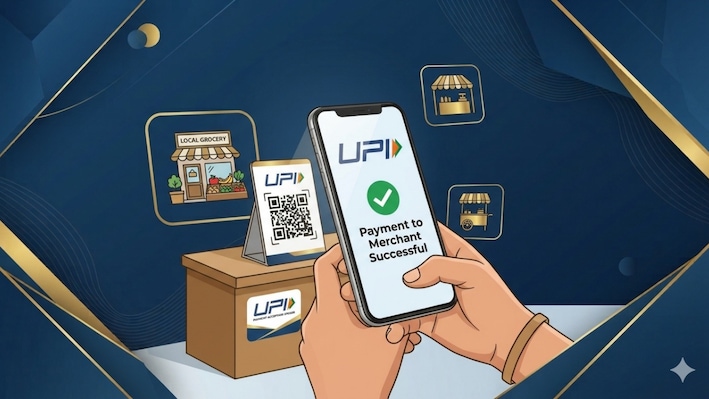
New Delhi: Merchants are awaiting a revised rollout date from the National Payments Corporation of India (NPCI) of Merchant Discount Rate (MDR) charges on select person-to-merchant (P2M) Unified Payments Interface (UPI) transactions.
NPCI had deferred the introduction of MDR charges beyond the originally planned October 15 rollout to avoid additional transaction costs during the festive season.
With Diwali celebrations over and Bhai Dooj falling on November 11, merchants and customers are awaiting clarity on implementation date as UPI and Services Steering Committee had decided that MDR these transactions would be implemented immediately after Diwali, with the exact effective date to be notified separately.
Merchant Discount Rate (MDR) is a merchant-side transaction fee that will be borne by the merchant receiving the payment, and the customer making the UPI transaction will remain unaffected. The NPCI had also clarified that the UPI transfers between individuals will remain free as proposed MDR will not apply to person-to-person (P2P) UPI transfers.
The government has clarified that customers would not have to bear the cost of the MDR. Person-to-person (P2P) transactions will continue to remain free, while P2M transactions of up to Rs 2,000 will also remain outside the MDR framework. This means consumers will continue to use UPI without paying any transaction charges.
Under the revised UPI framework, transactions of Rs 2,000 or lower would attract zero MDR. Also, transactions covered under the zero-MDR framework for small merchants will remain free. The category covers small vendors receiving up to Rs 1 lakh per month through UPI QR payments directly into their bank accounts. This brings approximately 96 percent of total P2M transactions outside the scope of MDR.
Also, select merchant categories including railways, telecom services, insurance and fuel purchases would attract a flat MDR of Rs 5 on UPI transactions exceeding Rs 2,000.
For P2M transactions of Rs 75,000 and above, the MDR will be capped at Rs 300.
Transactions with the capital market, including stockbroking, mutual funds and securities, would attract 0.02 percent MDR, capped at Rs 300, for transactions above Rs 2,000.
Note that automated recurring payments enabled through e-mandate will remain outside the MDR framework. It may include monthly subscriptions, utility bills, insurance premium etc.
The decision to defer the rollout came after heightened industry discussions around the reintroduction of MDR on certain categories of UPI transactions and its likely impact on merchant payments, fintech companies and the digital payments ecosystem.
Stay informed on all the latest news, real-time breaking news updates, and follow all the important headlines in india news and world news on Zee News English.